

Cell culture plates
I have found results from8000+products and3000+suppliers aboutCell culture plates
Commonly Used:
US$
—
Customization Available
Sample Available
Manufacturer First
Product Attributes:
Polishing: No-Polishing
Thickness: 3mm
Disposable: Disposable
Cleaning: Free Cleaning
Reactant State: Liquid
Rubber / Plastic
Certification: ISO
Diameter: 35mm
Power Source: Manual
Well Quantity: 96
Well Shape: Square
Bottom Shape: U Shape
Color: Clear
Customized: Customized
Structure: Portable
Application: Hospital
Without Ethylene Oxide Sterilization
Group: Adult
Without Logo Printing
Quality Guarantee Period: Two Years
Disposable: Non-Disposable
Material: Plastic
Certification: CE
Certification: RoHS
Application: Lab
Ethylene Oxide Sterilization
With Logo Printing

Satisfies 1 requirement
12well Laboratory Plastic Sterile Cell Tissue Culture Plate
US$0.83-0.95
50 box(MOQ)

Satisfies 1 requirement
Scientific Labs Use Thickened Material High Transparency Cell Culture Plate
US$0.60-0.90
1,000 Pieces(MOQ)


Satisfies 1 requirement
Laboratory Supplies Consumables 0.1ml 0.2ml Cell Culture Plate
US$0.10-1.00
1,000 Pieces(MOQ)

Satisfies 1 requirement
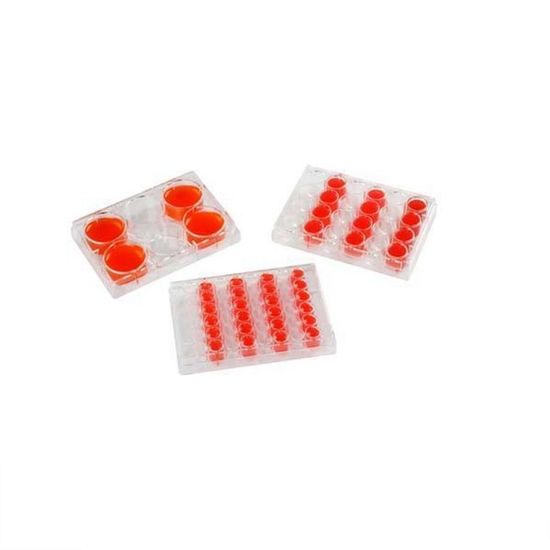
6-Well 12-Well 24-Well Multi-Well Cell Culture Plate with Cover Lid
US$0.021
200 Pieces(MOQ)

Satisfies 1 requirement
Laboratory Consumables Cell Culture Plate 6 Well/ 12 Well/ 24 Well/ 48 Well/ 96 Well Cell Culture Dish
US$0.30
1,000 Pieces(MOQ)

Satisfies 1 requirement
Bioland Cell Culture Series Non-Treat 6-Well Cell Culture Plate Ccp06n-006
US$0.60-1.00
50 pieces(MOQ)


Satisfies 1 requirement
Medical Supply Superior Quality 24 Wells Cell Culture Plate for Tissue Culture
US$0.55-0.691
5,000 Pieces(MOQ)

Satisfies 1 requirement
Wholesale Laboratory Disposable Plastic Lab PS Multi-Well Flat Bottom 24 Well Cell Culture Plate
US$0.55-0.82
50 pcs(MOQ)

Satisfies 1 requirement
Microtitation Cell Culture Plate with 6 Well/12 Well/24 Well/96 Well
US$0.40-0.80
5,000 Pieces(MOQ)

Satisfies 1 requirement
Dwp-96022-1 Transparent U Bottom Tissue Cell Culture 96 Square Well PCR 2.2ml Deep Well Plate
US$0.50
10,000 Pieces(MOQ)

Satisfies 1 requirement
Laboratory Consumables 6well 12well 24well 48well 96well Multi-Well Cell Culture Plate
US$0.31-0.83
1 Piece(MOQ)


Satisfies 1 requirement
Plastic Tissue Culture Treated 96 Well Cell Culture Plate
US$0.30-0.40
5,000 Pieces(MOQ)

Satisfies 1 requirement
Lab Consumables Disposable Universal Tc Processing 96 Well Cell Culture Plate
US$0.39-0.75
50 boxes(MOQ)

Satisfies 1 requirement
96-Well Sterile Tissue Culture Treated Cell Culture Plates
US$34.99
1 Piece(MOQ)

Satisfies 1 requirement
6-Well Sterile Tissue Culture Treated Cell Culture Plates
US$35.99
1 Piece(MOQ)

Satisfies 1 requirement
Laboratory Use Plastic PS 6/12/24/48/96 Well Factory Price Tc Treated Cell Culture Plate
US$33.80
1 Box(MOQ)

Satisfies 1 requirement
12 Holes Cell Culture Plate Disposable Plastic Microplate Tissue Bacteria Well Petri Dish 48 Holes Cell Culture Dish Plate for Laboratory
US$0.8555-0.9667
50 Pieces(MOQ)

Satisfies 1 requirement
6 Well 12 Well 24 Well 48 Well 96 Well Plastic Cell Growth Culture Plate Tissue Culture Plate for Lab
US$0.21-0.40
500 Pieces(MOQ)

Satisfies 1 requirement
2.2ml Polypropylene V Bottom 96 Deep-Well Deep Well Plate for Cell Culture with PCR Sealing Film
US$0.45-0.58
5,000 Pieces(MOQ)

Satisfies 1 requirement
Lab Consumables Plastic Sterile Micro Plate 48 Well Cell Culture Plate
US$0.26-0.27
50 Pieces(MOQ)


Satisfies 1 requirement
Standard Tissue Culture (TC) Treated Clear Multi-Well Cell Culture Plate
US$0.718-0.774
1 Piece(MOQ)

Satisfies 1 requirement
High-Quality Clear Cell Culture Empty 24 Well Titre Plates with Cap
US$0.46-0.47
100,000 Pieces(MOQ)
Sourcing guidance for Cell Culture Plates
How to choose the correct surface treatment for Cell Culture Plates?
The choice of surface treatment is critical for cell viability. For adherent cells, you must select plates with TC (Tissue Culture) treatment, which involves vacuum plasma discharge to make the polystyrene surface hydrophilic and negatively charged. For suspension cells, choose Non-Treated surfaces to prevent unwanted attachment. Specialized coatings like Poly-D-Lysine or Collagen are recommended for fastidious primary cells to enhance adhesion and growth.
What material and design specifications are essential for high-quality imaging?
Ensure the plates are manufactured from high-clarity, medical-grade USP Class VI Polystyrene. For fluorescence or luminescence assays, use black or white-walled plates with clear bottoms to prevent 'crosstalk' between wells. The bottom thickness should be consistent, ideally 0.16-0.19mm, to be compatible with high-resolution confocal microscopy and automated plate readers.
What are the key compliance and sterility standards for laboratory use?
All plates must be DNase-free, RNase-free, and non-pyrogenic (endotoxin levels <0.5 EU/ml) to ensure experimental integrity. Verify that the supplier uses Gamma Irradiation sterilization and provides a Certificate of Analysis (CoA) for every batch. Compliance with ISO 13485 for medical devices is a strong indicator of a reliable manufacturer.
How do well-plate designs affect evaporation and contamination control?
Look for plates featuring a condensation ring design on the lid and individual raised rims around each well; these features significantly reduce the risk of cross-contamination and minimize the 'edge effect' (evaporation) during long-term incubation. For high-throughput screening, ensure the plate dimensions conform to ANSI/SLAS standards for robotic arm compatibility.
Cross-Border Procurement & Risk Management for Labware
What are the primary risks when shipping fragile plastic labware internationally?
The main risks are physical deformation and micro-cracks caused by pressure or temperature fluctuations during transit. To mitigate this, insist on double-walled corrugated export cartons and palletized shipping to minimize manual handling. Ensure the supplier uses moisture-proof inner packaging to maintain sterility if the outer box is compromised.
How can I verify a supplier's technical capability on Made-in-China.com?
Prioritize Audited Suppliers on Made-in-China.com who have undergone third-party inspections by SGS or TÜV Rheinland. Request a video audit of their cleanroom facilities (Class 100,000 or higher) and ask for historical export data to your specific region to ensure they understand local customs requirements for biological laboratory consumables.
What negotiation strategies should be used for bulk cell culture plate orders?
Since these are high-volume consumables, negotiate based on annual volume commitments rather than one-off orders to secure 15-25% discounts. Request free samples (usually 1-2 cases) to test with your specific cell lines before finalizing a contract. Also, negotiate Incoterms like CIF or DAP if you do not have a dedicated lab-equipment freight forwarder, as specialized handling is required.
How to ensure transaction security and quality alignment?
Utilize Secured Trading services on Made-in-China.com to protect your payment until the goods are dispatched. Define a strict Quality Acceptance Agreement (QAA) that specifies the allowable AQL (Acceptable Quality Level) for defects like scratches or sterilization seal breaches. If the batch fails a third-party pre-shipment inspection, the supplier should be contractually obligated to replace the lot.